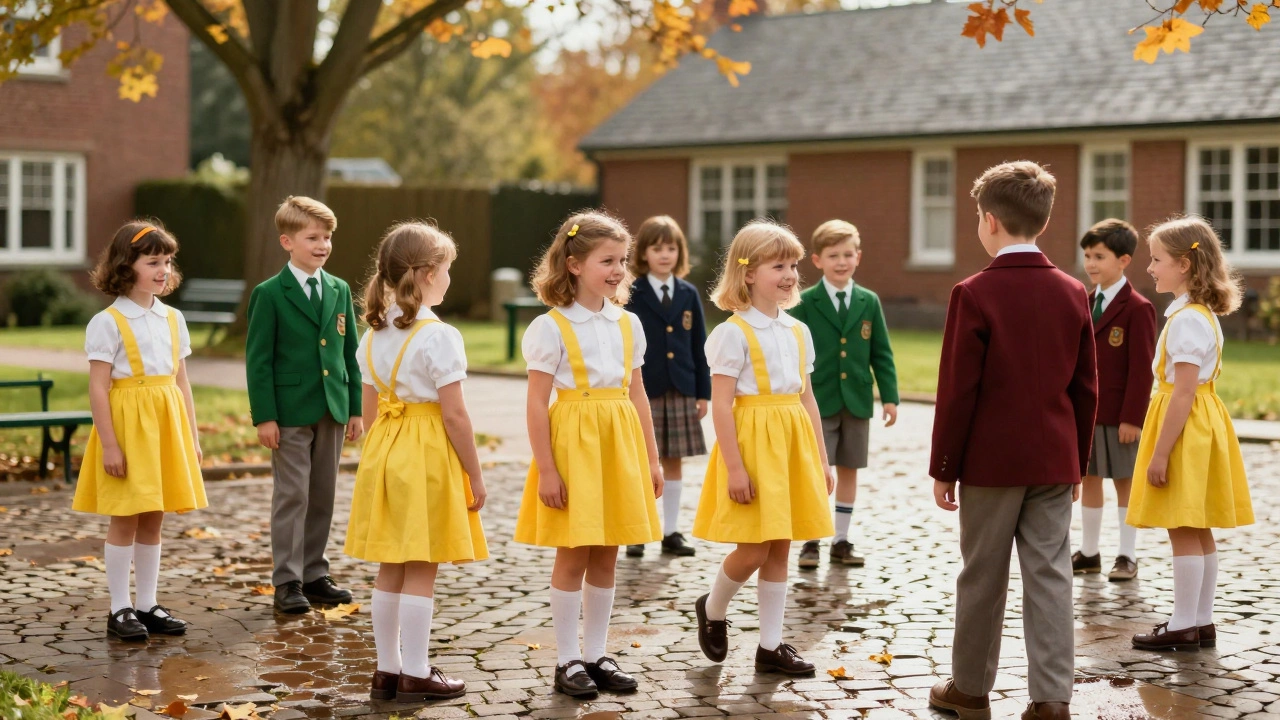
Irish School Uniform Evolution & Cost Calculator
Select an era to see how Irish school uniforms changed over time.
1950s - 60s
Era of Bright Identities
1970s - 80s
Shift to Practicality
2020s - Present
Inclusivity & Comfort
Dominant Colors:
Navy, Green, Yellow, Red, White
Key Garments:
Pinafores, Blazers, Knitted Jumpers
Why this look?
Specific colors were associated with patronage (parish or diocese). It created a visual map of the community where teachers could identify students by their distinct colored blazers or pinafores.
Uniform Cost Estimator
Calculate the difference between buying specialized vintage-style items versus modern standardized bulk items.
Includes custom colors, specific tailoring, and branded items.
Includes generic navy/grey polos, sweatshirts, and trousers.
By opting for the standard monochrome palette favored since the 1980s.
Walk down the street outside any primary or secondary school in Dublin, Cork, or Galway on a rainy Tuesday morning, and you will see a sea of navy blue, grey, and black. The vibrant reds, greens, and yellows that once dotted the playgrounds have largely vanished. If you are wondering when did school uniforms stop being colorful, the answer isn’t a single date. It is a slow fade that happened over decades, driven by practicality, cost, and a shift in how we view childhood.
In Ireland, the story of the school uniform is deeply tied to our social history. For many families, especially those who grew up in the mid-20th century, the uniform was not just clothing; it was a marker of identity, class, and sometimes, religion. Today, as parents navigate the high costs of living and schools debate dress codes, looking back at why our uniforms turned so drab offers some surprising insights.
The Era of Bright Identities: Pre-1970s
To understand why things changed, we have to look at what came before. In the 1950s and 60s, school uniforms in Ireland were far more distinct-and often brighter-than they are today. This wasn't just about style; it was about belonging.
Catholic primary schools, which made up the vast majority of state-funded education at the time, often had specific colors associated with them. You might see girls in bright yellow pinafores or boys in distinctive green blazers depending on the patronage of the school. These colors helped teachers quickly identify students from their own parish or diocese. It created a visual map of the community.
Consider the iconic pinafore. While often white or pale blue, these dresses were frequently worn over brightly colored jumpers or blouses mandated by the school. In rural areas like County Kerry or Donegal, local tailors would make uniforms using fabrics that reflected regional availability, leading to subtle variations in shade and pattern across the country.
| Era | Dominant Colors | Key Garments | Purpose |
|---|---|---|---|
| 1950s-60s | Navy, Green, Yellow, Red, White | Pinafores, Blazer, Knitted Jumpers | Community Identity, Patronage Distinction |
| 1970s-80s | Navy, Grey, Black | Sweatshirts, Tracksuits, Plain Trousers | Practicality, Cost Reduction |
| 2020s-Present | Navy, Grey, Black, White | Polo Shirts, Hoodies, Joggers | Inclusivity, Comfort, Budget |
This era also saw the rise of branded uniform suppliers. Companies like Moss Bros and local family-run outfitters began standardizing designs. However, even then, there was room for color. A school in Limerick might choose a burgundy tie, while one in Belfast opted for royal blue. The variety was real, but it was becoming more regulated.
The Shift to Monochrome: Practicality Takes Over
So, when did the color drain away? The turning point came in the late 1970s and early 1980s. Several factors converged to push schools toward a monochrome palette.
Rising Costs: As inflation hit Ireland hard in the 1970s, parents complained about the expense of specialized uniforms. Brightly colored fabrics were often more expensive to dye and maintain. Navy blue and grey became the go-to choices because they hid dirt better and were cheaper to produce. For a family in Tallaght or Phibsborough, buying a plain navy blazer was significantly less costly than a custom-colored one.
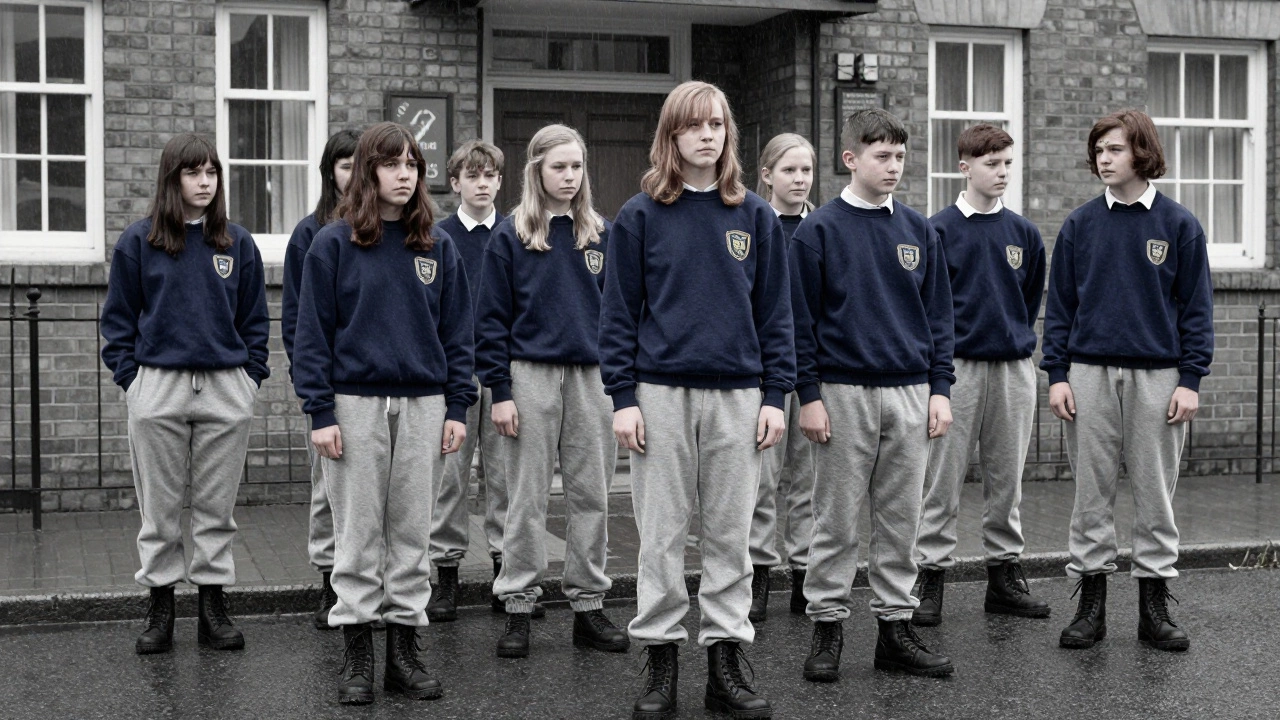
The Rise of Sweatshirts: Perhaps the biggest change was the introduction of the sweatshirt. In the 1980s, schools started allowing or mandating sweatshirts with the school crest embroidered on them. These were almost exclusively navy, grey, or black. Why? Because embroidery thread in bright colors frayed easily and looked messy after washing. Navy blue provided a neutral background that worked for every school, regardless of its original "house" colors.
Standardization Across Denominations: As Ireland moved away from strict religious segregation in education, schools sought a unified look. The Department of Education encouraged policies that reduced visible markers of difference. A plain grey uniform meant a child from a Catholic school and a child from a Protestant school could look similar, promoting integration in mixed communities.
The Role of Retail Giants
By the 1990s, large retailers entered the uniform market. Stores like Penneys (now Primark) and SuperValu began selling pre-made uniform items. To keep prices low, they produced items in bulk. Bulk production favors simple, dark colors. Producing a run of 10,000 navy polo shirts is efficient. Producing 1,000 each in ten different colors is not.
This retail shift cemented the dominance of navy and grey. Parents found it easier to buy a generic navy jumper from Penneys than to order a specific colored one from a specialist shop. The convenience factor outweighed the desire for tradition. Even today, if you walk into a supermarket in Derry or Waterford, the uniform section is dominated by dark tones.
Modern Debates: Comfort vs. Tradition
Today, the conversation around school uniforms in Ireland has shifted again. It’s no longer just about color; it’s about comfort, gender neutrality, and cost of living.
In 2023, several schools in Dublin announced changes to their dress codes to be more inclusive. Some removed mandatory skirts for girls, allowing trousers instead. Others dropped the requirement for ties, citing discomfort during long school days. But interestingly, few schools have reintroduced bright colors. Instead, they have focused on softer fabrics and relaxed fits within the traditional navy/grey/black framework.
Why? Because parents are still sensitive to cost. A brightly colored uniform implies a need for precise matching. If your daughter loses her yellow jumper, you can’t just grab any old jumper from the laundry basket-it has to be the right shade. With navy, you have flexibility. You can mix and match items from different brands without worrying about clashing hues.
Furthermore, research from the National Council for Curriculum and Assessment (NCCA) suggests that overly restrictive dress codes can cause anxiety among students. Schools are responding by making uniforms more comfortable, not more colorful. Think soft cotton polos instead of stiff collared shirts, and elasticated waistbands instead of belts.
Exceptions That Prove the Rule
Are there any schools in Ireland still wearing colorful uniforms? Yes, but they are rare. Most are private institutions or international schools. For example, some Anglo-Norman schools in Dublin retain traditional blazers with colored badges or ties. Similarly, certain Gaelic Athletic Association (GAA)-linked schools might incorporate green and gold into their sports kits, though not necessarily their daily wear.
Primary schools are slightly more likely to allow color. Many permit children to wear colorful PE kits on Fridays or during sports days. But for Monday through Thursday, the rule remains: keep it dark, keep it simple, keep it cheap.

What Does This Mean for Irish Families?
If you are a parent in Ireland today, navigating the uniform landscape means embracing simplicity. Here are some practical tips based on current trends:
- Stick to Navy and Grey: These colors are universally accepted. You can buy second-hand items from charities like The Salvation Army or online platforms like Adore Me with confidence that they will fit most school requirements.
- Check for Embroidery Policies: Some schools require crests. Ensure you know whether this must be done professionally or if iron-on patches are acceptable. This can save you €20-€40 per item.
- Layering is Key: Irish weather is unpredictable. Invest in a good quality waterproof jacket in navy or black. It should be durable enough to last three years, covering primary to junior cycle.
- Avoid Fast Fashion Traps: Cheap, brightly colored fast-fashion items may look appealing but often shrink or fade after one wash. Stick to basic cuts from reputable brands.
The loss of color in school uniforms reflects a broader societal shift in Ireland: from rigid, community-defined identities to flexible, individual-focused lifestyles. We traded vibrancy for versatility. And while we may miss the sight of a rainbow of pinafores on a sunny day in Killarney, most parents agree that saving money and reducing stress was worth the trade-off.
Looking Ahead: Will Color Return?
It’s unlikely. The trend toward minimalism in fashion continues. Brands like Uniqlo and H&M dominate the casual wear market with neutral palettes. Schools are mirroring this. Unless there is a major cultural revival demanding distinct visual identities, Irish school uniforms will remain firmly planted in the shades of navy, grey, and black.
However, innovation is happening elsewhere. Some schools are experimenting with sustainable materials-recycled polyester, organic cotton-to reduce environmental impact. This focus on ethics over aesthetics suggests that the future of the uniform is about substance, not surface shine.
Why are most Irish school uniforms navy blue?
Navy blue became dominant because it is practical, hides dirt well, and is cheaper to produce in bulk. It also serves as a neutral base for embroidery and works across all denominations and genders.
Did Catholic schools in Ireland used to have different colored uniforms?
Yes, in the mid-20th century, many Catholic schools used specific colors like yellow, green, or red to distinguish themselves by parish or diocese. This practice faded as schools standardized for cost and inclusivity.
Can I buy second-hand school uniforms in Ireland?
Absolutely. Charities like The Salvation Army and St. Vincent de Paul offer affordable second-hand uniforms. Online marketplaces like Adore Me and Facebook Marketplace are also popular sources for gently used items.
Are there any schools in Ireland that still use colorful uniforms?
Very few. Most exceptions are private or international schools. Some primary schools allow colorful PE kits, but daily uniforms remain predominantly navy, grey, or black.
How much does a typical school uniform cost in Ireland today?
A basic uniform can range from €100 to €300 depending on the number of items required. Schools with strict branding requirements tend to be more expensive due to mandatory embroidery fees.