
Boot Width Calculator (AD vs EE)
Enter Measurements
Trace your foot on paper while standing, then measure in centimeters.
Your Result:
You are likely an AD (Standard) Width
Your foot proportions suggest a standard fit. Most boots labeled 'Medium' or 'Regular' should accommodate your feet comfortably.
- Look for standard D width men's or B width women's sizes.
- If buying winter boots, consider sizing up slightly for thick socks.
You are likely an EE (Wide) Width
Your foot is wider than average. Standard boots may pinch your toes or cause blisters on the sides.
- Search specifically for "Wide Fit" or "EE" labels.
- Brands like Clarks or Ecco often have better wide options.
- Lace-up styles offer more adjustability than slip-ons.
You are on the Borderline
Your measurements fall between standard and wide. You might fit into AD widths, but could be uncomfortable in tight leather boots.
- Try both AD and EE widths if possible.
- For winter boots with thick socks, choose EE.
- Look for elastic panels or soft leather materials.
Enter your measurements to see if you need
AD or EE width boots.
Standing in a shoe shop on Grafton Street, you’ve probably been there. You slide your foot into a beautiful pair of women's boots, only to feel that familiar pinch at the toes or the slide at the heel. It’s frustrating, especially when you’re trying to navigate the rainy streets of Dublin or the cobblestones of Galway. The real question isn’t just about size; it’s about width. Are you an AD (narrow) or an EE (wide)? Knowing this distinction is the secret to comfortable footwear without spending hours trying things on.
In Ireland, where our weather demands sturdy, reliable footwear and our terrain ranges from city pavements to rugged coastal paths, getting the fit right is essential. This guide breaks down exactly what these letters mean, how to measure yourself at home, and where to find the best fits for your specific foot shape.
What Do AD and EE Actually Mean?
When you look at the inside of a boot tongue or a product listing online, you’ll often see numbers followed by letters. The number is your length (like UK 6 or EU 39), but the letter tells you the width. This system is standard across most European brands, including those we love here in Ireland.
- AD Width: This stands for "Average" or "Standard" width. In many systems, 'D' is the standard men's width, and 'B' is the standard women's width. However, some brands use 'AD' to denote a slightly narrower than average fit, or simply as a code for the standard medium width. If you buy shoes off the rack in stores like Brown Thomas or Marks & Spencer and they fit fine, you are likely an AD width.
- EE Width: This indicates a "Wide" fit. 'E' is wide, and 'EE' is extra-wide. If your feet feel squeezed in standard boots, or if you have higher arches that require more volume, EE is likely your friend.
It’s important to note that sizing isn’t perfectly uniform. A UK 6 in one brand might feel tighter than a UK 6 in another. This is why understanding your own foot dimensions is more valuable than relying solely on the tag.
The Simple At-Home Test: Are You AD or EE?
You don’t need a fancy podiatrist appointment to figure this out. You can do a quick check at your kitchen table. Here is how to determine if you lean towards AD or EE.
- The Paper Trace: Place a sheet of paper on a hard floor (not carpet). Stand on it with your weight evenly distributed. Trace the outline of your foot.
- Measure the Width: Use a ruler to measure the widest part of the trace (usually across the ball of the foot, near the knuckles).
- Compare to Length: Measure the length of your foot from heel to longest toe.
Now, look at the ratio. If your foot width is roughly 50-55% of its length, you are likely a standard AD width. If your width is closer to 60% or more of the length, you are probably an EE width. For example, if your foot is 24cm long and 12cm wide, that’s a 50% ratio (AD). If it’s 24cm long and 14.5cm wide, that’s nearly 60% (EE).
Signs You Might Be an EE (Wide Fit)
If you aren't sure about the measurements, look at how your current boots behave. Here are common signs that you need an EE width rather than an AD:
- Blisters on the Sides: If you get blisters on the inner or outer edges of your feet after walking around Temple Bar or up the steps of St. Stephen’s Green, your boots are too narrow.
- Toes Overlapping: Look at your toes when wearing socks. If your big toe pushes against the second toe, or if your pinky toe hangs off the edge of your insole, you need more width.
- Slipping Heel: Paradoxically, if your boots are too narrow in the forefoot, your foot will splay forward, causing your heel to slip out with every step. Going up a width (to EE) often solves heel slippage because the foot sits flatter.
- Numbness: Feeling pins and needles after an hour of wear is a clear sign of compression. Your nerves are being pinched by the sides of the boot.
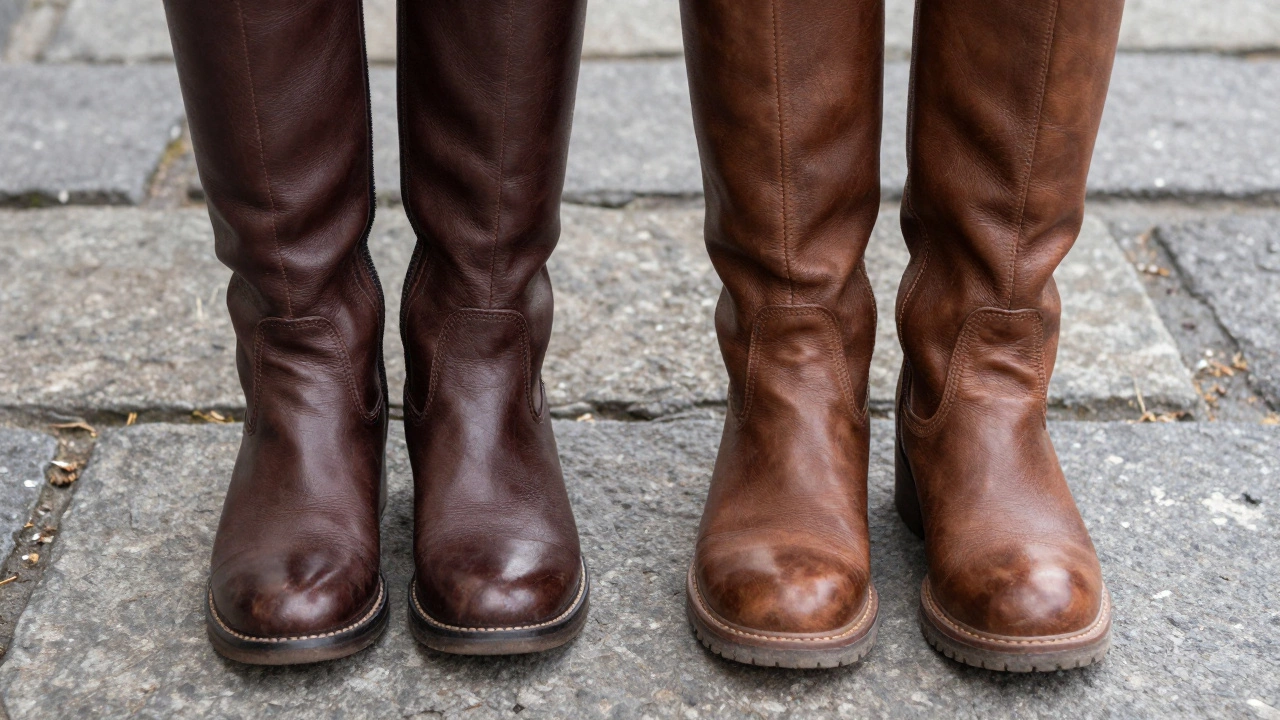
Why Width Matters More in Winter Boots
In Ireland, winter means thick socks. We’re talking wool blends, thermal layers, and sometimes even two pairs if you’re commuting on the Luas or walking in the wind off the Liffey. An AD width boot might fit perfectly with thin cotton socks in summer, but become unbearable in January.
If you know you are on the border between AD and EE, it is usually smarter to go for the EE width in winter boots. The extra space allows for thicker socks without compressing your circulation. Poor circulation in cold weather leads to colder feet, which is the last thing you want during a damp Irish evening.
Finding Wide Fit Boots in Ireland
Shopping for EE width boots in Ireland has gotten much easier. While high-street stores in areas like Dundrum Town Centre or The Square in Bray may have limited wide sizes in-store, online retailers have expanded their offerings significantly.
| Store/Retailer | Best For | Width Options |
|---|---|---|
| Clarks (Online & Stores) | Comfortable everyday boots | Excellent range of EE widths |
| Jack Wills | Stylish Chelsea boots | Limited EE, mostly AD |
| Boots.ie | High street fashion | Some EE options in key styles |
| Dr. Martens | Durable work/casual boots | Run wide naturally, but EE available |
| Local Cobblers (e.g., Dublin Shoe Repair) | Stretching existing boots | Custom adjustments |
Brands like Clarks and Ecco are particularly good for EE widths. They design their lasts (the mold the shoe is built on) to accommodate wider feet without looking bulky. If you prefer fashion-forward brands, check online filters on sites like ASOS Ireland or Zalando, which allow you to filter specifically by "Wide Fit."
Can You Stretch an AD Boot to Fit Like an EE?
If you’ve already bought a pair of AD width boots that pinch, don’t throw them away yet. Leather and suede can be stretched, but there are limits. You can typically stretch a boot by half a width (from D to E), but going from AD to EE is a big jump.
Visit a local cobbler in your area-every town from Cork to Donegal has one. They can use mechanical stretchers to widen the toe box. However, this doesn’t increase the height of the instep. If you have high arches, stretching won’t help enough. In that case, returning the boot for an EE width is the better long-term solution.
Pro Tips for Buying Wide Fit Boots Online
Buying boots online in Ireland is convenient, but returns can be a hassle, especially with courier services. Here’s how to minimize risk:
- Read Reviews for Keywords: Search reviews for words like "wide," "tight," or "roomy." If multiple people say "runs narrow," avoid it unless you size up significantly.
- Check the Return Policy: Ensure the retailer offers free returns within 28 days. Most major Irish and EU retailers do.
- Look for Elastic Panels: Some boots feature elastic side panels or gussets. These provide flexibility for wider feet without needing a strict EE width label.
- Consider Lace-Up Styles: Lace-up boots allow you to adjust the tightness around the ankle and instep. Slip-on Chelsea boots are less forgiving if you have a high instep.
Conclusion: Comfort Is Key
Whether you’re an AD or an EE, the goal is comfort. Don’t suffer through tight boots just because they look good in the window. Your feet carry you through life, from hiking the Wicklow Mountains to commuting on the DART. Invest in the right width, and you’ll thank yourself later.
Is AD width the same as narrow?
Not exactly. AD usually refers to a standard or average width. Narrow widths are often labeled as B or AA. If you are an AD, you fit into standard off-the-rack shoes. If you are narrower than AD, you might need B width.
Do all brands use the same width sizing?
No. Sizing varies between brands. A UK 6 EE in one brand might fit like a UK 6.5 AD in another. Always check the specific brand’s size guide and read customer reviews for fit advice.
Should I buy wider boots if my feet swell?
Yes. If your feet swell during the day due to standing, heat, or pregnancy, buying an EE width provides necessary room. Tight boots can restrict blood flow and cause discomfort or health issues.
Where can I get my boots stretched in Dublin?
There are several reputable cobblers in Dublin, such as those on Grafton Street or in the Smithfield area. They can stretch leather boots by half a size or more. Call ahead to confirm services.
Are EE width boots ugly?
Not necessarily. Many modern brands design wide-fit boots that look sleek and stylish. Brands like Clarks and Ecco offer fashionable styles in EE widths that don’t look bulky.